From Rote Learning to Real Thinking: What Competency-Based Education Looks Like Day-to-Day

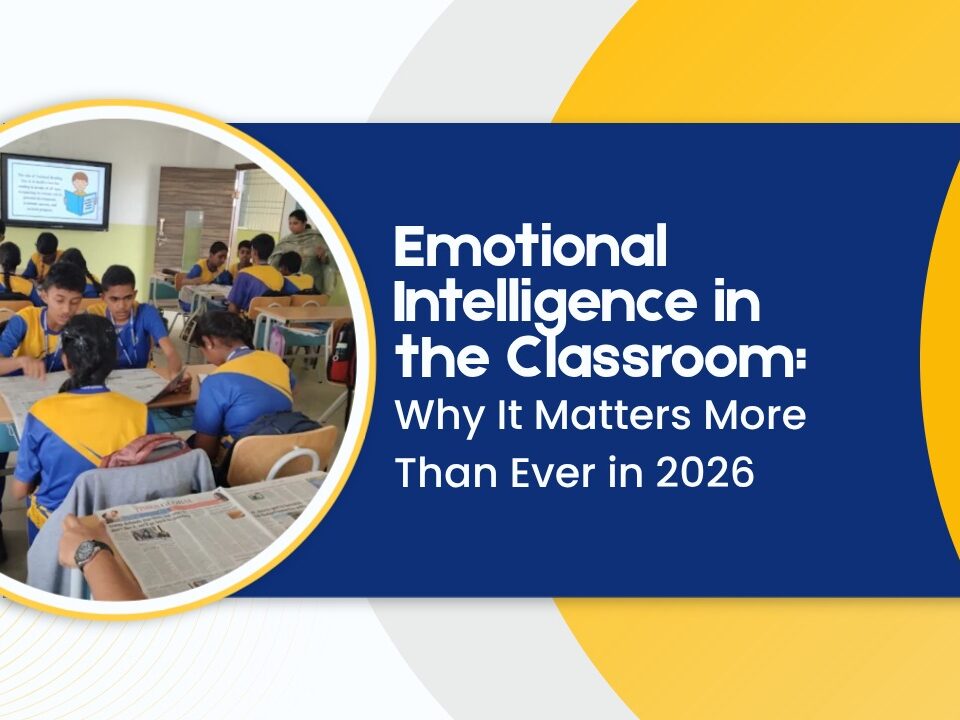
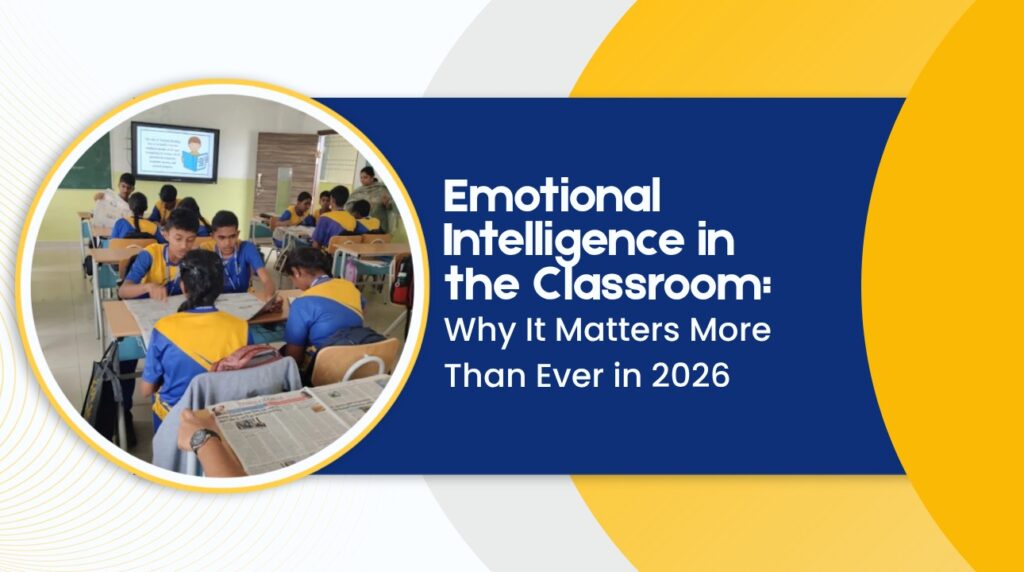
Emotional Intelligence in the Classroom: Why It Matters More Than Ever in 2026
August 22, 2026
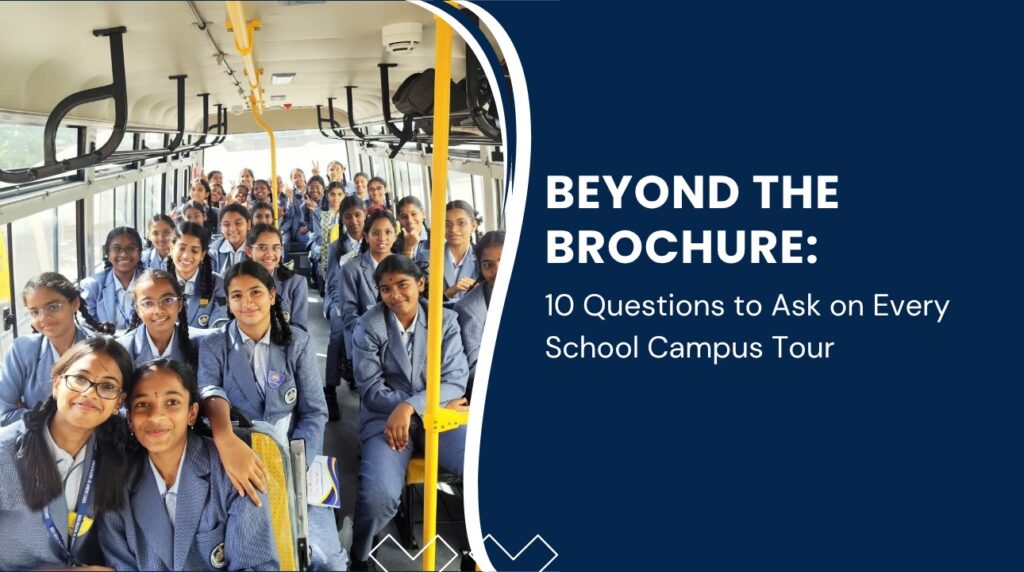
Beyond the Brochure: 10 Questions to Ask on Every School Campus Tour
September 23, 2026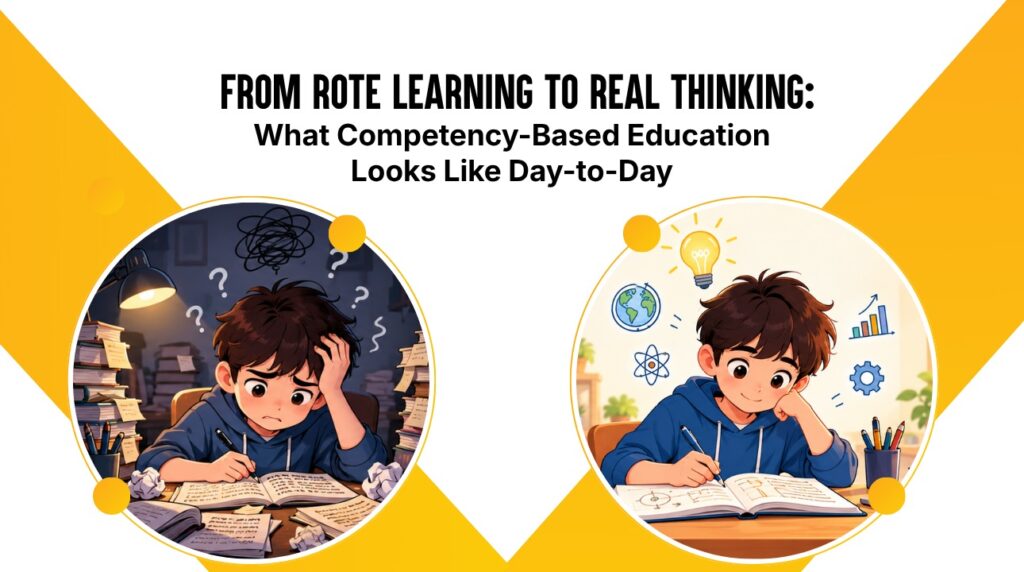
Ask a child, “What did you learn in school today?” and you may hear the familiar answer: “Nothing.”
Now change the question.
“What problem did you solve today?”
Suddenly, there may be a story to tell.
Perhaps they measured the classroom to understand area. Maybe they debated whether plastic should be banned, used fractions while dividing materials for an activity, or explained a science concept to a classmate in their own words.
That difference matters.
Competency-based education shifts the focus from how much information a student can remember to what they can actually understand, apply, analyse and communicate. Learning is no longer complete simply because a chapter has been taught. The real question becomes: Can the student use what they have learned?
Competency-Based Education Is Not About Removing Knowledge:
One common misconception is that competency-based education in schools means textbooks, facts and examinations become unimportant.
They don’t.
Knowledge remains the foundation. What changes is what students are expected to do with that knowledge.
Consider a lesson on water conservation.
A conventional approach might ask students to learn the causes of water scarcity and reproduce five conservation methods in an examination.
A competency-based learning approach could go further. Students might observe water usage at home, identify where water is being wasted, estimate how much could be saved and suggest practical solutions.
The topic remains the same. The depth of learning changes.
Students move through a valuable progression:
Know → Understand → Apply → Analyse → Explain
That last part is especially important. A child who can explain why an answer makes sense has usually understood more than one who simply remembers it.
What Does Competency-Based Education Look Like at 10:30 on a Tuesday?
The best way to understand this approach is not through educational terminology, but through an ordinary classroom.
Mathematics: From “Find X” to “Why Does X Matter?”
Students learning percentages could calculate discounts on imaginary products, compare two offers and decide which one actually provides better value.
They are still practising percentages.
But they are also learning comparison, reasoning and decision-making.
Science: From Reading an Experiment to Investigating One
Instead of only reading about seed germination, students could grow seeds under different conditions.
What happens without sunlight? What changes when there is too much water? Why did one plant grow faster?
When students predict, observe, record, and explain results, science stops being a collection of answers and becomes a process of discovery.
English: From Memorising Answers to Building an Argument
After reading a story, students could be asked:
“Do you agree with the character’s decision? Defend your answer using evidence from the story.”
There may not be one perfect response.
That is precisely the point.
Students have to interpret information, form an opinion, and support it logically. Reading comprehension becomes thinking practice.
Experiential Learning in Schools Makes Lessons Easier to Connect With:
Children frequently ask a surprisingly useful question:
“When will I ever use this?”
Good learning should give them an answer.
Experiential learning in schools connects classroom concepts with situations children can observe, investigate, or experience.
Measurement can happen through mapping a room. Environmental science can involve examining waste generated on campus. Language learning can include presentations, conversations, and storytelling. Mathematics can appear in budgeting and data collection.
At Sristi Global School, the educational philosophy places emphasis on experiential learning alongside areas such as science and technology, communication, environmental awareness, arts, and values.
This creates opportunities for children to see subjects not as isolated chapters but as different ways of understanding the world around them.
The Teacher’s Role Changes Too:
In a rote-learning classroom, the teacher can easily become the person who provides the answer.
In competency-based learning, teachers often become the people who ask the next useful question.
Instead of:
“No, that’s incorrect.”
A teacher might ask:
“How did you reach that answer?”
Or:
“What would happen if we changed this condition?”
Or simply:
“Can you show me another way?”
These questions reveal something a right-or-wrong worksheet may miss: how the child is thinking.
That gives teachers a better opportunity to identify misconceptions early and help students improve the process, not merely correct the final answer.
Assessment Becomes More Than a Mark on a Paper:
Suppose two students both score 8/10.
Student A understands the concept but makes two calculation errors.
Student B remembers the correct method but cannot explain why it works.
The score looks identical. Their learning needs are completely different.
This is where competency-focused assessment becomes useful.
Teachers can look at multiple indicators such as written work, projects, classroom participation, practical activities, presentations, and a student’s ability to apply concepts in unfamiliar situations.
Assessment then answers a more useful question than “How many marks did the child get?”
It asks:
“What can the child confidently do, and what still needs strengthening?”
The Benefits of Competency-Based Education for Students Go Beyond Exams:
One of the biggest benefits of competency-based education for students is that children practise skills while learning academic content rather than waiting until adulthood to develop them.
They learn to:
- ask better questions and investigate possible answers;
- connect concepts instead of memorising them separately;
- explain their reasoning clearly;
- collaborate and listen to different viewpoints;
- apply knowledge when a problem looks unfamiliar;
- learn from mistakes rather than treating mistakes only as lost marks.
These abilities become particularly valuable when students encounter a question that does not look exactly like the example in their textbook.
Because real life rarely comes with a solved example on the previous page.
What Should Parents Look for in a Competency-Based Classroom?
Parents evaluating competency-based education in schools can look beyond labels and brochures.
During a school interaction, ask practical questions.
“Can you show me an example of a project students recently completed?”
“How do teachers know whether a child has understood a concept rather than memorised it?”
“What happens when a student can give the correct answer but cannot explain the reasoning?”
“How are classroom concepts connected with practical activities?”
The answers can tell you far more about the learning culture than educational terminology alone.
Quick tip 1: When your child comes home, replace “What marks did you get?” occasionally with “What did you figure out today?”
Quick tip 2: If your child gives an answer, ask “How do you know?” It is a simple way to encourage reasoning without turning home into another classroom.
The Goal Is Not to Remember More. It Is to Understand Better.
Rote learning can help a student remember the answer to a question they have already seen.
Education has a bigger job.
Students need to face questions they have not seen before, make connections, test ideas, communicate their thinking, and decide what to do when the answer is not immediately obvious.
That is where competency-based education becomes meaningful.
At Sristi Global School, the emphasis on experiential learning, communication, science and technology, environmental awareness, arts, and values provides a broader setting in which academic knowledge can connect with skills and everyday experiences.
Because eventually, the most important test of learning is not:
“Can you remember what the teacher taught?”
It is:
“Can you use what you learned when nobody has shown you the answer?”
For parents exploring a learning environment that encourages children to understand, question, apply, and grow, Sristi Global School offers an approach worth discovering.
Connect with Sristi Global School to learn more about its learning approach, programmes, and admissions.