CBSE Curriculum 2026-27 Explained: What Every Parent Needs to Know Before Admissions

Why Experiential Learning Is the Future of Education in India
July 30, 2026
Emotional Intelligence in the Classroom: Why It Matters More Than Ever in 2026
September 22, 2026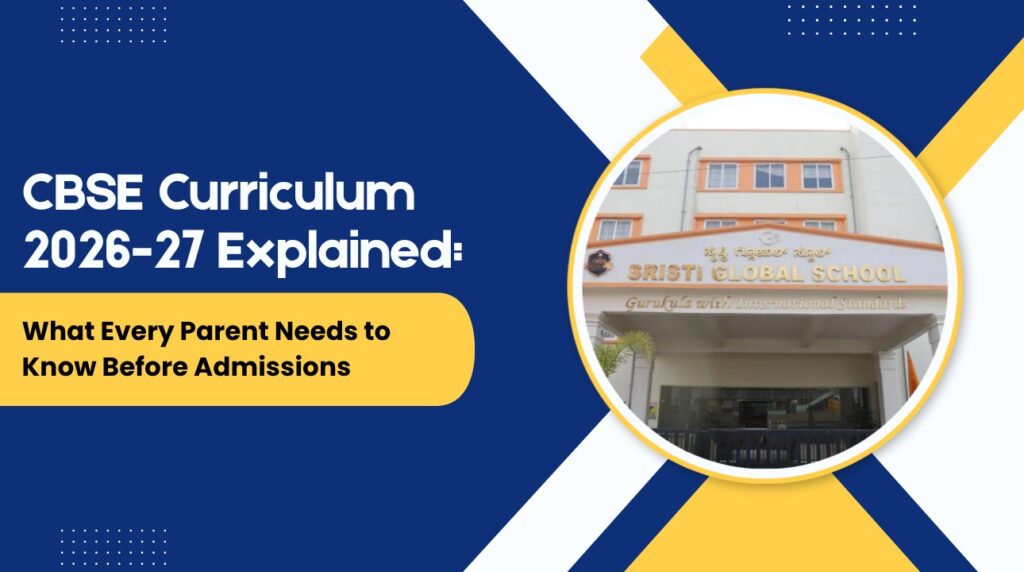
Choosing a school is difficult enough. Now add words like NEP, competency-based assessment, experiential learning, AI, skill education, and two board examinations to the conversation, and many parents are left wondering:
What exactly is changing in CBSE? Will my child have more pressure or less? Will there still be exams? Is memorisation no longer important? And, most importantly, how do I know whether a school is actually implementing these changes well?
These are important questions for families considering CBSE School Admissions 2026-27.
The CBSE Curriculum 2026-27 is not simply about a revised list of chapters. The larger shift is in how children are expected to learn: understanding concepts, applying knowledge, solving problems, communicating ideas and developing skills rather than depending mainly on memorisation.
So before selecting a school because it has “CBSE” on its prospectus, parents need to look deeper.
What Has Actually Changed in the CBSE Curriculum 2026-27?
CBSE’s direction for 2026–27 continues to align school education with NEP 2020 and the National Curriculum Framework for School Education 2023. The emphasis is increasingly moving toward competency, application, flexibility, skill development and holistic growth.
For parents, this means a child’s school day should gradually look different from the traditional “teacher explains, child memorises, child writes exam” model.
You should expect to see more:
- Concept-based questioning.
- Experiments and hands-on activities.
- Projects and presentations.
- Real-life application of mathematics and science.
- Discussions and problem-solving.
- Art, physical education, and skill-based learning.
- Continuous feedback rather than depending only on final examinations.
CBSE itself describes its curriculum as focusing on constructivist learning, hands-on experience, competency development, and the application of knowledge in real-life situations.
What Does This Mean for Your Child?
Consider a simple example.
In a traditional classroom, a child might memorise the formula for calculating area.
In a competency-focused classroom, the child may be asked:
“You have to carpet your bedroom. Measure the floor, calculate the area, and work out how much carpet would be required.”
The formula is still learned. The difference is that children must understand when, why, and how to use it.
That distinction is one of the biggest Benefits of CBSE Curriculum changes parents should understand.
Your Child Will Still Study Seriously — But Rote Learning Alone Will Not Be Enough:
A common misunderstanding among parents is that experiential or competency-based education means academics are becoming easier.
It doesn’t.
In many ways, good conceptual learning can be more demanding because students cannot simply reproduce a memorised answer.
They may need to:
- Interpret information
- Compare two ideas
- Explain reasoning
- Apply a concept in an unfamiliar situation
- Analyse data
- Find solutions instead of recalling definitions
CBSE’s SAFAL framework, for example, assesses Grades 3, 5 and 8 around core concepts, application of knowledge and higher-order thinking skills, rather than treating recall alone as evidence of learning.
Parent takeaway: During a school visit, don’t ask only, “How many tests do you conduct?”
Ask:
“Can you show me examples of the kind of questions and activities children are given?”
The answer will tell you much more about the school’s actual teaching quality.
One of the Biggest 2026-27 Developments Is Happening in Class IX:
For parents of older students, the CBSE Curriculum 2026-27 deserves particularly close attention.
CBSE’s published Class IX structure for 2026–27 includes subjects such as:
- Two languages
- Mathematics or Mathematics Advanced
- Science or Science Advanced
- Social Science
- Vocational Education or Kaushal Vikas
- Individuals in Society
- Art Education
- Physical Education and Well-being
- Computational Thinking & AI modules
CBSE has also listed several optional skill areas.
Why should parents care?
Because secondary education is gradually becoming less about forcing every child through exactly the same academic pathway and more about recognising differences in aptitude, interests, and future direction.
If your child is approaching secondary school, ask the school:
How will you help us decide the right academic level or subject choice for our child?
A choice made simply because “all the high scorers take it” may not necessarily be the right choice for every learner.
Yes, Class X Now Has Two Board Examination Opportunities:
This is another major point under What parents should know before CBSE admissions.
Beginning with the 2026 examinations, CBSE introduced two Class X board examination opportunities.
The first/main board examination is compulsory. Eligible students can use the second examination to improve performance in up to three permitted subjects. Both examinations cover the full year’s syllabus.
For parents, the intention should not be interpreted as:
“My child gets two attempts, so the first one doesn’t matter.”
Instead, it gives students another opportunity while reducing the feeling that one examination day determines everything.
A strong school should therefore prepare children consistently throughout the year—not create last-minute board-exam panic.
AI and Technology Are Entering Education — But Don’t Choose a School Just Because It Has Smart Boards:
Parents today naturally look for robotics, coding, AI, smart classrooms, and digital learning.
And technology does have a growing place in CBSE education. In fact, the 2026–27 Class IX structure includes Computational Thinking and AI modules, with CBSE indicating further integration ahead.
But here’s the question parents often miss:
What is the child actually doing with the technology?
A smart board displaying the same textbook page is not educational innovation.
Technology adds value when children use it to investigate, create, calculate, design, experiment or solve problems.
So during CBSE School Admissions 2026-27, don’t simply ask whether the school has a computer lab or robotics program.
Ask:
- How often do students use these facilities?
- What do they create or learn?
- Is technology connected to classroom concepts?
- How is screen exposure balanced with physical, social and hands-on learning?
That gives you a much clearer picture.
The Benefits of CBSE Curriculum Depend Heavily on the School:
This is perhaps the most important thing parents should know.
Two schools may both follow CBSE and still give children completely different experiences.
CBSE provides the academic framework. The school determines how that framework comes alive every day.
One school may teach a science concept through notes and worksheets.
Another may combine the same concept with demonstrations, experiments, questions and projects.
Same curriculum. Very different learning.
That’s why parents evaluating CBSE School Admissions 2026-27 should look beyond board affiliation and examine the school’s teaching culture.
Your Pre-Admission Checklist: 8 Questions Worth Asking
Before paying the admission fee, have a proper conversation with the academic team.
1. How do you teach a difficult concept to a child who doesn’t understand it the first time?
Listen carefully to this answer. It reveals far more than a school’s result percentage.
2. How much homework is given at my child’s age?
More homework does not automatically mean stronger academics.
3. How are children assessed apart from written tests?
Look for projects, oral work, activities, observation, presentations, and application-based assessments.
4. What happens when a child performs poorly?
Does the school simply send lower marks home—or identify the learning gap and help the child improve?
5. How do you balance academics with sports, arts, and wellbeing?
One of the Benefits of CBSE Curriculum is its scope for holistic development, but the school must actually provide these opportunities.
6. How do teachers communicate progress to parents?
A report card tells you what your child scored. Good teacher feedback should also tell you what your child understands, where they struggle and what should happen next.
7. How is technology being used?
Ask for examples, not just a list of facilities.
8. What kind of child does your school hope to develop by Grade 10?
This question often reveals the school’s true educational philosophy.
Where Sristi Global School Fits Into This Changing Approach:
For parents considering CBSE School Admissions 2026-27 in and around KR Puram, the conversation should go beyond textbooks and examination preparation.
Sristi Global School positions its approach as “Gurukula With International Standards,” combining academic learning with values, experiential education and contemporary skills.
Its learning framework includes areas such as experiential learning, communication and language enrichment, science and technology, Sadvidya for moral values and ethics, Gandharva Veda for fine arts, sports, environmental awareness, safety and self-defence. The campus also lists facilities such as smart boards, science and computer labs, a library, robotics, a dance room and yoga and meditation facilities.
This becomes particularly relevant under the changing CBSE approach because academic knowledge is only one part of school readiness. Children also need communication, confidence, curiosity, physical wellbeing, values and the ability to apply what they learn.
Don’t Ask “Which Is the Best CBSE School?” Ask This Instead
Parents often search for the best CBSE school near me.
A better question is:
“Which school will help my child learn well, feel supported and gradually become capable of thinking independently?”
Your child may spend eight hours a day at school for more than a decade. That’s thousands of hours during the years when habits, confidence, friendships, interests and self-belief are being formed.
Choosing a school purely because of infrastructure, board results or brand recognition can therefore miss the bigger picture.
The CBSE Curriculum 2026-27 is increasingly designed around understanding, competency, skills, and holistic development. The right school should make these ideas visible in everyday classrooms—not simply mention them in its brochure.
Considering Sristi Global School for 2026-27?
If you’re exploring admissions, visit Sristi Global School, observe the learning environment and speak with the academic team about how the curriculum is implemented for your child’s grade.
The school’s website currently lists admissions for the academic year 2026-27.
Because the best admission decision isn’t the one that looks impressive on paper.
It’s the one that makes sense for the child who will walk into that classroom every morning.
Frequently Asked Questions(FAQs):
1. What is different about the CBSE Curriculum 2026-27?
A) The curriculum continues CBSE’s shift toward competency-based, experiential, and application-oriented learning aligned with NEP 2020 and NCFSE 2023. The 2026–27 secondary structure also reflects greater attention to skill education, computational thinking, AI, physical wellbeing, and flexible learning pathways.
2. Does competency-based learning mean fewer exams?
A) Not necessarily. Students are still assessed academically, but good assessment increasingly checks understanding, reasoning, and application rather than memorisation alone.
3. What are the major Benefits of CBSE Curriculum for students?
A) Some important benefits include a nationally recognised academic framework, emphasis on conceptual understanding, competency-based learning, skill development and flexibility in subject options at higher grades.
4. What parents should know before CBSE admissions?
A) Parents should verify more than the curriculum. Ask about teaching methods, assessment practices, teacher support, class environment, subject choices, extracurricular opportunities, student wellbeing, technology use, and communication with parents.
5. How should I compare schools during CBSE School Admissions 2026-27?
A) Compare the actual learning experience rather than only fees, infrastructure, and advertised results. Ask schools to explain how concepts are taught, how struggling learners are supported, and how academic, social, emotional, and physical development are balanced.