Emotional Intelligence in the Classroom: Why It Matters More Than Ever in 2026

CBSE Curriculum 2026-27 Explained: What Every Parent Needs to Know Before Admissions
September 18, 2026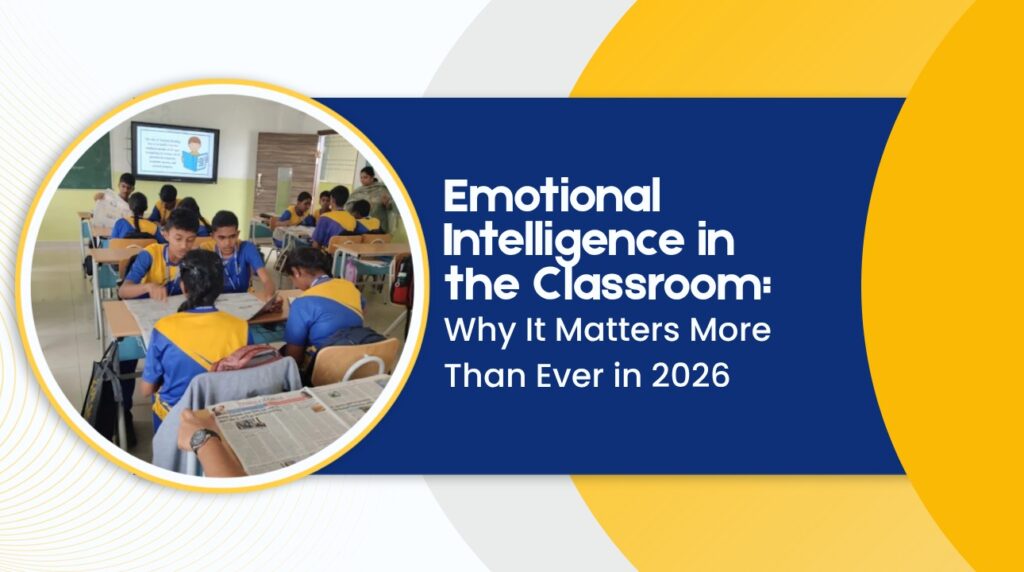
A child can know the correct answer in mathematics and still freeze when asked to explain it in front of the class.
They can score well in science and still struggle when a friend refuses to include them in a game.
They can memorise an entire lesson but give up the moment an unfamiliar problem appears on a test.
For parents, these situations can be confusing.
“My child knows the answer. Why are they afraid to speak?”
“Why does one low score upset them so much?”
“Why can’t they handle being corrected?”
“Why does a small disagreement with a friend affect their whole day?”
Sometimes, the missing piece isn’t academic ability at all.
It is emotional intelligence.
And in 2026, Emotional Intelligence in the Classroom deserves as much attention as many of the academic skills parents traditionally look for when choosing a school.
What Is Emotional Intelligence in the Classroom?
Emotional Intelligence in Education is a child’s developing ability to understand emotions—their own and other people’s—and respond to those emotions constructively.
It involves several interconnected abilities:
- Recognising what they are feeling
- Understanding why they feel that way
- Managing impulsive reactions
- Communicating emotions appropriately
- Showing empathy toward others
- Handling disagreement
- Recovering from disappointment
- Asking for help
- Making thoughtful decisions
- Continuing to try when something is difficult
These skills may sound simple until you watch a child actually need them.
Consider what happens when a teacher says:
“That’s not quite right. Try once more.”
One student feels embarrassed and stops participating.
Another thinks for a moment, asks a question, and tries again.
Both experienced the same situation.
What differed was how they managed it.
That’s why Emotional Intelligence in Schools isn’t separate from learning—it influences how children participate in learning every single day.
Why 2026 Makes Emotional Intelligence Even More Important:
Children today are growing up in an environment very different from the one their parents experienced.
Information arrives instantly. Social comparison can happen through screens. AI can answer questions within seconds. Children are exposed earlier to technology, opinions, and constant feedback.
But knowing more information doesn’t automatically teach a child how to deal with:
- Rejection
- Failure
- Competition
- Nervousness
- Criticism
- Friendship problems
- Peer pressure
- Teamwork
- Waiting
- Frustration
Technology may change considerably by the time today’s students enter university or the workplace.
Their need to communicate, collaborate, adapt, and understand other people will remain.
The OECD’s international work on social and emotional skills examines capabilities such as persistence, responsibility, self-control, stress resistance, curiosity, empathy, and trust because these abilities are associated with important educational and life outcomes.
That makes Emotional Learning in Schools particularly relevant to education in 2026.
The Report Card Doesn’t Tell You Everything About How Your Child Is Learning:
Imagine two children both receive 65% on a test.
The first says:
“I’m terrible at this subject. I’m never going to understand it.”
The second says:
“I got these questions wrong. Can I understand what I missed?”
The number on the report card is identical.
The learning behaviour is completely different.
The second response involves emotional regulation, self-awareness, persistence and willingness to seek help.
Those qualities can influence what happens in the child’s next test.
This is one reason emotional learning shouldn’t be treated as an optional add-on that schools address only during special workshops.
CASEL’s research reviews have found that well-designed social and emotional learning programmes can improve social-emotional skills and behaviour while also supporting academic performance. A major meta-analysis involving more than 270,000 students found an average academic achievement gain of 11 percentile points among participating students compared with controls.
More recent CASEL analysis published in April 2026 also found an association between integrating social-emotional learning into academic instruction and stronger Grade 3 reading outcomes, while noting that the data demonstrate a relationship rather than proving SEL alone caused the improvement.
What Emotional Intelligence Looks Like in an Ordinary Classroom:
Parents may imagine Emotional Intelligence in the Classroom as children sitting in a circle talking about feelings.
That can be part of it—but emotional learning goes much further.
| Everyday Situation | Skill Being Developed |
| Waiting for a turn to speak | Self-control |
| Losing a sports match | Emotional regulation |
| Completing a difficult puzzle | Persistence |
| Working with classmates | Collaboration |
| Hearing another opinion | Respect and open-mindedness |
| Presenting in front of the class | Confidence and emotional management |
| Admitting a mistake | Self-awareness |
| Helping an upset classmate | Empathy |
| Resolving a disagreement | Communication |
| Receiving teacher feedback | Resilience |
This is an important point for parents.
Emotional learning doesn’t always need an extra period on the timetable.
It can happen through the way lessons, activities, sports, conversations, and relationships are structured throughout the school day.
Emotional Intelligence Does Not Mean Children Never Feel Upset:
There is another misconception worth clearing up.
An emotionally intelligent child isn’t a child who is always calm, cheerful, and agreeable.
Children will get angry.
They will feel jealous.
They will lose competitions.
They will argue with friends.
They will sometimes be disappointed with their marks.
The goal of Emotional Intelligence in Education is not to eliminate those emotions.
It is to gradually teach children:
“I can feel this emotion without allowing it to control everything I do next.”
For example, imagine two children want the same role in a school play.
A school could simply choose one child and move on.
Or the experience can become an opportunity to learn how to handle disappointment, congratulate someone else, understand selection decisions, and remain involved positively.
Those little experiences matter.
Why a Child’s Relationship With Teachers Matters:
Think about the last time you made a mistake in front of someone who made you feel uncomfortable.
You probably became more cautious.
Children experience the same thing.
If students constantly worry about being embarrassed when they answer incorrectly, they eventually learn something unintended:
Don’t take risks.
But learning requires risk.
A child has to attempt a difficult answer.
Read aloud.
Ask what may seem like a “silly” question.
Try something unfamiliar.
A classroom where students feel heard and respected makes these learning behaviours easier.
CASEL identifies a supportive classroom climate, integration of social-emotional development into academic instruction, and explicit instruction in social-emotional skills as important components of SEL-focused classrooms.
This is one reason the quality of teacher-student interaction should matter enormously to parents evaluating a school.
Six Benefits of Emotional Intelligence in Education That Parents May Notice:
The Benefits of emotional intelligence in education don’t always appear as dramatic changes. Often, they show up gradually in everyday behaviour.
1. “I Don’t Understand” Replaces “I Can’t Do It”:
Emotionally aware students can gradually separate difficulty from ability.
Instead of treating one mistake as proof that they are “bad” at something, they learn to identify what they haven’t understood yet.
That mindset can encourage persistence.
2. Children Become Better at Asking for Help:
Some children struggle silently because asking for help feels embarrassing.
A supportive classroom teaches them that not understanding something is part of learning.
Being able to say “Can you explain this again?” is a surprisingly valuable skill.
3. Friendships Become Easier to Navigate:
Childhood friendships involve misunderstandings, jealousy, sharing, competition, and disagreement.
Empathy and communication don’t remove these situations, but they help children handle them better.
4. Group Work Becomes Real Learning:
In adult life, very little meaningful work happens completely alone.
Group activities teach students to listen, contribute, negotiate, divide responsibilities, and handle different personalities.
These are emotional and social skills alongside academic ones.
5. Children Can Handle Feedback Better:
Feedback is useful only when a student can receive it.
If every correction feels like personal criticism, improvement becomes difficult.
Emotional intelligence helps children begin separating:
“My work needs improvement”
from
“There is something wrong with me.”
6. Confidence Becomes More Grounded:
Confidence isn’t believing you will always win.
Real confidence sounds more like:
“I might not know how to do this yet, but I can try.”
That is a much more useful foundation for long-term learning.
Emotional Intelligence Activities for Students That Actually Have a Purpose:
Good Emotional intelligence activities for students don’t have to feel artificial or overly complicated.
Emotion Check-Ins:
Young students can learn to identify whether they’re feeling excited, nervous, frustrated, tired or calm.
Naming an emotion is the first step toward learning how to manage it.
“What Would You Do?” Situations
Teachers can introduce age-appropriate scenarios:
Your friend didn’t choose you for their team. What could you do?
Students can discuss several responses and their possible consequences.
Reflection After Group Projects:
Instead of discussing only the final project, teachers can ask:
- Did everyone participate?
- What disagreement occurred?
- How did your group solve it?
- What would you change next time?
Suddenly, one science activity teaches teamwork too.
Story and Character Discussions:
Literature offers endless opportunities for emotional learning.
Why do you think this character behaved that way?
What might the other person have felt?
Would you have responded differently?
Questions like these build perspective-taking.
Sports and Games:
Some of the strongest emotional lessons happen outside the classroom.
Waiting for a turn, losing fairly, following rules, supporting teammates, and continuing after mistakes are all valuable forms of emotional development.
Journaling and Reflection:
Older students can reflect on challenges, decisions, and goals.
The aim isn’t simply writing—it is developing the habit of examining their own thoughts and actions.
Five Questions Parents Should Ask a School About Emotional Intelligence:
When visiting a school, parents often ask about fees, books, examination results, transport, and infrastructure.
Those things matter.
But try asking these too:
“What happens when my child makes a mistake in class?”
You will quickly understand whether mistakes are treated primarily as failures or learning opportunities.
“How do teachers handle conflict between students?”
Look for an answer that includes accountability and communication—not punishment alone.
“What happens if my child is shy and doesn’t participate?”
The answer reveals how teachers respond to different personalities.
“How do you teach children to work together?”
Group activities are meaningful only when collaboration itself is guided.
“How will you tell me if my child is struggling emotionally or socially?”
Good school-parent communication shouldn’t begin only when marks decline.
These questions can reveal far more about Emotional Intelligence in Schools than a brochure ever will.
How Sristi Global School Brings Empathy Into Education:
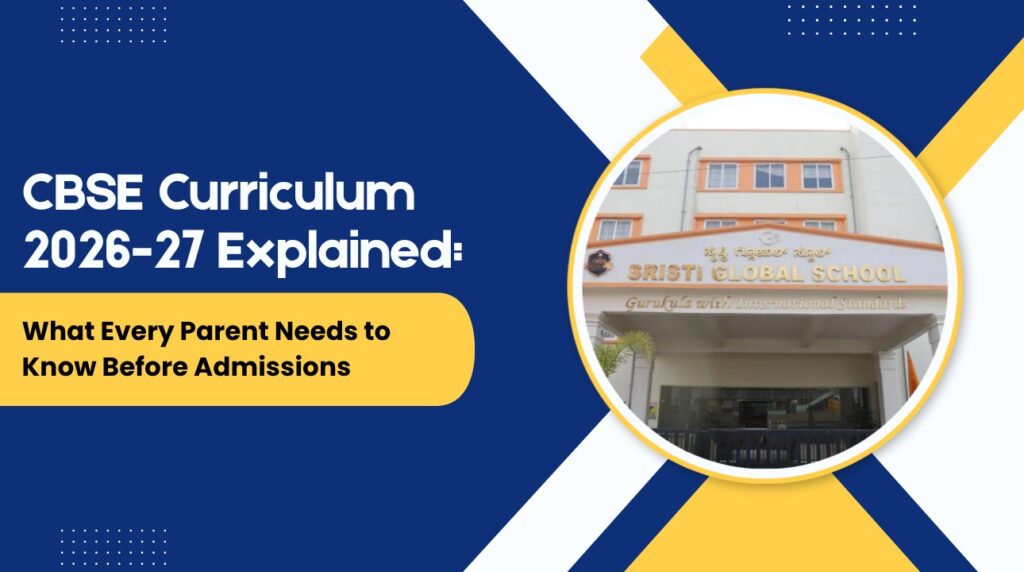
At Sristi Global School, the idea of emotional development connects closely with the school’s broader child-centric philosophy.
One particularly relevant part of its approach is STEM – Student-Teacher Empathy. The school describes this as teachers working to understand students’ personal and social situations while showing care and concern in response to their emotions. Sristi also highlights open communication, active listening, and understanding individual learning needs as part of building stronger student-teacher relationships.
This approach is supported by other elements within Sristi Global School, including:
- Sadvidya – Moral Values and Ethics
- Experiential learning
- Communication and language enrichment
- Gandharva Veda – Fine Arts
- Sports
- Safety and self-defence
- Yoga and meditation
- Child-centric learning
The school’s experiential learning approach also encourages students to take initiative, make decisions, and become accountable for their learning.
Together, these experiences create opportunities for children to develop qualities that cannot be built through textbooks alone.
Academic Intelligence Gets Children Through Tests. Emotional Intelligence Helps Them Through Life.
Parents naturally want children to become academically capable.
But consider what children will eventually need outside an examination hall.
They will need to work with difficult people.
Recover when something doesn’t go according to plan.
Speak when they are nervous.
Accept criticism.
Make responsible choices.
Understand other perspectives.
Manage pressure.
Keep trying after failure.
These are not secondary abilities.
They are part of becoming capable adults.
That is why Emotional Learning in Schools deserves a meaningful place alongside mathematics, science, languages, and technology.
What Kind of Child Do You Want School to Help You Raise?
When parents compare schools, the conversation often becomes:
Which school has better infrastructure?
Which one gives more homework?
Which school gets higher marks?
There is another question worth adding:
Who is my child becoming while they are learning here?
Are they becoming curious?
Can they communicate?
Do they feel safe admitting a mistake?
Can they cope when they don’t win?
Do they notice how someone else feels?
Can they stand up for themselves respectfully?
These qualities may not receive a numerical grade.
But they influence the kind of student, friend, colleague, and adult your child eventually becomes.
At Sristi Global School, the focus on empathy, values, experiential learning, communication, sports, and holistic education recognises that preparing children for the future requires more than academic knowledge alone.
Because in 2026, education isn’t just about helping children become smarter.
It is also about helping them understand themselves, other people, and the world they are preparing to enter.
Frequently Asked Questions(FAQs):
1. What is Emotional Intelligence in the Classroom?
A) Emotional Intelligence in the Classroom means helping students recognise and manage their emotions, communicate effectively, understand others, resolve conflicts, handle setbacks and make responsible decisions alongside academic learning.
2. Why is Emotional Intelligence in Education important?
A) Emotional Intelligence in Education can support persistence, communication, teamwork, self-control, confidence and students’ ability to cope with challenges. Research on social-emotional learning has also linked well-designed programmes with positive academic and behavioural outcomes.
3. What are the main Benefits of emotional intelligence in education?
A) Important Benefits of emotional intelligence in education include stronger self-awareness, better emotional regulation, healthier peer relationships, improved communication, resilience, empathy and greater ability to receive feedback and persist with difficult learning.
4. What are some useful Emotional intelligence activities for students?
A) Effective Emotional intelligence activities for students include emotion check-ins, role-play, reflective journaling, collaborative projects, classroom discussions, storytelling, sports, perspective-taking exercises and reflecting on how conflicts or challenges were handled.
5. How can parents tell whether Emotional Learning in Schools is genuinely happening?
A) Observe how teachers interact with students and ask how the school handles mistakes, disagreements, shy children, poor performance, and peer conflict. Genuine Emotional Learning in Schools should be visible in everyday interactions rather than limited to occasional workshops.
6. How does Sristi Global School support emotional development?
A) Sristi Global School integrates Student-Teacher Empathy, moral values and ethics, communication, experiential learning, sports, fine arts, yoga, and other child-centric experiences into its wider approach to holistic education.