Bringing Back Gurukula Values in Modern Education: Why It Matters Today

Top School Education Trends in East Bangalore for the Academic Year 2026–27
June 25, 2026
Why Experiential Learning Is the Future of Education in India
July 30, 2026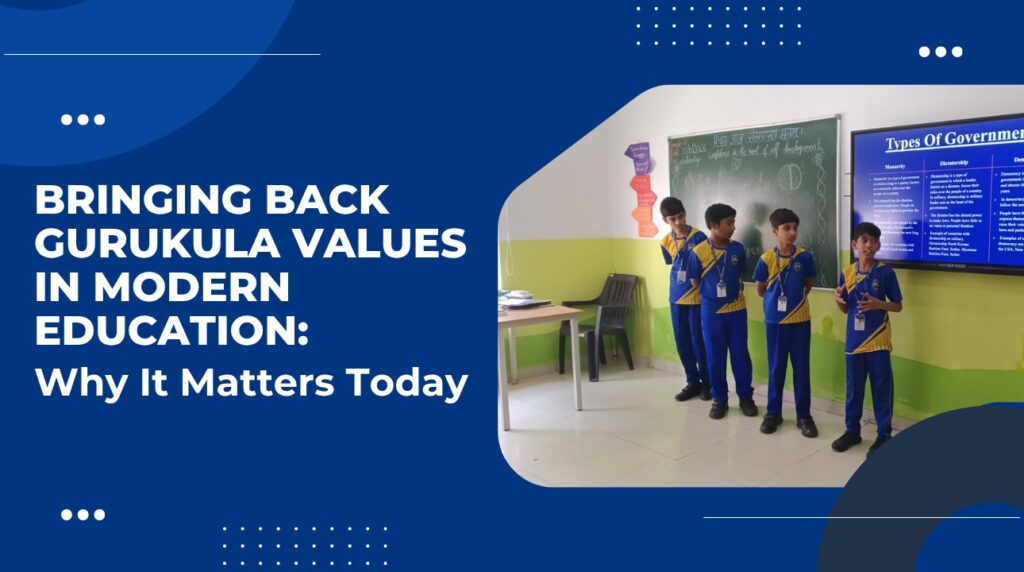
Imagine a child waking up each morning with more than a timetable to follow.
There is learning, but not just inside a classroom. There is discipline, but not fear. There is a teacher, but not merely someone who completes a syllabus. There is time to ask questions, work with others, develop practical skills, understand responsibilities, and discover one’s own strengths.
This was the spirit of the Gurukula education system.
While the ancient Gurukul system cannot—and should not—be replicated exactly in the 21st century, its core values remain remarkably relevant. In a world where children are growing up surrounded by screens, academic pressure, constant comparison, and fast-changing information, education must do more than prepare them for examinations.
It must prepare them to think, adapt, communicate, make responsible decisions, and live with purpose.
This is why many parents and educators are increasingly exploring the principles behind Gurukul education in Bangalore and asking an important question:
Can the wisdom of Gurukula learning help shape a better model of modern education?
The answer lies not in going backwards—but in bringing forward the values that still matter.
What Was the Gurukula Education System?
The traditional Gurukula education system was based on a close relationship between the teacher and the learner. Students lived and learned in an environment where education extended beyond textbooks.
The Guru was not simply a subject teacher. The Guru served as a:
- Teacher
- Mentor
- Guide
- Role model
Students learned academic subjects, but education also included practical knowledge, discipline, self-reliance, values, physical development, social responsibility, and an understanding of their duties.
The central idea was simple:
Education should develop the whole person—not just the memory.
This principle is highly relevant to modern discussions around holistic education in Bangalore.
Why Are Gurukula Values Relevant in Modern Education?
Today’s children have access to more information than any previous generation. A child can find an answer to almost any question within seconds.
But access to information does not automatically create:
- Wisdom
- Emotional maturity
- Discipline
- Empathy
- Critical thinking
- Responsible decision-making
This is where the values associated with the Gurukula model become important.
Modern education can combine academic knowledge with the development of the character and capabilities needed to use that knowledge wisely.
The question is not whether schools should choose ancient education or modern education.
The more important question is:
What can modern education learn from the best principles of the Gurukula tradition?
The Benefits of the Gurukula Education System for Today’s Learners:
The benefits of the Gurukula education system go beyond traditional academic learning. Its principles can offer valuable insights for schools looking to create more balanced, meaningful learning environments.
1. Learning Through Mentorship, Not Just Instruction:
One of the most important Gurukula values was the close bond between the teacher and the student.
A teacher understood the learner’s:
- Strengths
- Areas of difficulty
- Interests
- Behaviour
- Progress
This is very different from viewing students simply as names on a class list.
In modern schools, strong teacher-student relationships can help children feel:
- Seen
- Heard
- Supported
- Confident enough to ask questions
When students trust their teachers, they are more likely to participate actively and learn from mistakes.
This is one of the most valuable lessons modern schools can take from the Gurukula tradition.
2. Education Beyond Textbooks:
The ancient Gurukula approach recognised that learning does not happen only through reading and writing.
Children can learn through:
- Observation
- Discussion
- Practical tasks
- Nature
- Collaboration
- Reflection
- Everyday responsibilities
This idea is closely connected to holistic learning through the Gurukul system.
A modern version of this approach may include:
- Experiential learning
- Project-based activities
- Sports and physical education
- Art and music
- Life skills
- Group work
- Community-oriented activities
The goal is to help children understand that knowledge is not separate from life.
3. Discipline as Self-Management:
When people hear the word “discipline”, they often think of rules and punishment.
But one of the deeper lessons from the Gurukula tradition is that discipline can also mean learning to manage oneself.
Modern children need the ability to:
- Focus on a task
- Manage time
- Follow routines
- Delay gratification
- Complete responsibilities
- Make thoughtful choices
These skills become increasingly important in a world of constant digital distractions.
The most effective modern schools therefore focus on developing self-discipline, rather than relying only on external control.
4. The Importance of Practical Learning:
Imagine learning about responsibility only from a textbook.
A child may understand the definition of responsibility but may not know how to practise it.
This is why practical experiences are so valuable.
Children can develop responsibility by:
- Working as part of a team
- Managing classroom tasks
- Caring for shared spaces
- Completing projects
- Solving real-world problems
This reflects the spirit of holistic learning through the Gurukul system, where education was connected to everyday life.
The modern interpretation is not about recreating ancient routines. It is about ensuring that children have opportunities to apply what they learn.
Gurukul Education in Bangalore: What Could It Look Like Today?
When parents search for Gurukul education in Bangalore, they may imagine traditional residential learning environments.
However, bringing Gurukula values into modern education does not necessarily mean recreating the original Gurukul structure.
Instead, schools can incorporate its core principles through a modern, age-appropriate approach.
For example:
A Modern Gurukula-Inspired Classroom May Encourage:
- Strong teacher mentorship
- Learning through experience
- Respectful communication
- Independent thinking
- Collaboration
- Responsibility
- Reflection
- Ethical decision-making
- Connection between learning and real life
This approach can coexist with modern curriculum frameworks, technology, scientific learning, digital tools, and contemporary teaching methods.
In fact, the combination of traditional values and modern learning methods may be exactly what many children need today.
How Holistic Education in Bangalore Is Evolving:
The demand for holistic education in Bangalore reflects a broader change in how parents view school education.
Academic performance remains important. But parents are also asking:
- Is my child confident?
- Can my child communicate clearly?
- Can my child handle setbacks?
- Does my child know how to work with others?
- Is my child developing curiosity?
- Can my child think independently?
- Is my child becoming responsible?
These questions highlight an important truth:
A child’s education cannot be measured only through examination scores.
A holistic approach seeks to develop multiple dimensions of growth, including:
Intellectual Growth:
Understanding concepts, asking questions, analysing information, and solving problems.
Emotional Growth:
Recognising feelings, developing empathy, and learning to manage challenges.
Social Growth:
Collaborating with others, communicating respectfully, and appreciating different perspectives.
Physical Growth:
Developing fitness, coordination, discipline, and healthy habits.
Ethical Growth:
Understanding responsibility, honesty, respect, and the consequences of one’s choices.
This is where the values of the Gurukula system remain particularly meaningful.
The Role of Teachers in a Modern Gurukula-Inspired Approach:
The teacher’s role has changed significantly.
Modern teachers are expected to be:
- Subject experts
- Facilitators
- Mentors
- Observers
- Encouragers
This is closely aligned with the traditional idea of the Guru as a guide who supported the learner’s overall development.
However, the modern version must be inclusive and student-centred.
Every child may learn differently. Some students may be highly verbal. Others may learn better through visuals, movement, experimentation, or practical work.
A strong teacher does not expect every child to learn in exactly the same way.
Instead, the teacher helps each learner discover how to learn effectively.
Can Technology and Gurukula Values Coexist?
Absolutely.
The choice is not:
Technology OR traditional values.
It can be:
Technology WITH responsibility.
A child may use digital tools to:
- Research a topic
- Create a presentation
- Explore a simulation
- Collaborate on a project
- Learn through visual resources
At the same time, the child must also learn:
- When technology is useful
- When it becomes a distraction
- How to evaluate information
- How to communicate responsibly online
This combination is essential in modern education.
The Gurukula values of discipline, reflection, responsibility, and mentorship can provide the ethical foundation that helps children use technology wisely.
What Parents Can Look for in a School Inspired by These Values:
Parents do not need to look only for a school that uses the word “Gurukul” in its name.
Instead, look at what the school actually does.
Ask:
Does the school see the child beyond marks?
A school should recognise academic, emotional, social, creative, and physical development.
Do teachers know their students well?
Meaningful relationships are an important part of effective education.
Are children given opportunities to learn by doing?
Projects, activities, experiments, discussions, and real-world connections can make learning more meaningful.
Is discipline based on fear or responsibility?
The goal should be to help children gradually develop self-management.
Are values practised or simply displayed on walls?
Respect, empathy, honesty, teamwork, and responsibility should be visible in the everyday school culture.
Does the school balance modern skills with strong values?
Children need both. Digital literacy without responsibility can be problematic. Values without future-ready skills can also leave children unprepared.
The strongest education brings both together.
How Sristi Global School Connects Modern Learning with Timeless Values:
The future of education does not require children to choose between tradition and technology, academic excellence and creativity, or discipline and freedom.
The most meaningful approach is one that brings the right elements together.
At Sristi Global School, the principles behind holistic education are reflected in an approach that aims to support the development of the whole child.
The school focuses on creating learning experiences where students can develop:
- Academic understanding
- Confidence
- Communication skills
- Creativity
- Collaboration
- Responsibility
- Emotional awareness
This reflects the deeper spirit of the Gurukula education system—education that aims to shape capable, thoughtful, and responsible individuals.
The goal is not to recreate the past.
It is to take the values that remain relevant and apply them thoughtfully to the needs of children growing up today.
Why the Gurukula Approach Matters in a Fast-Changing World:
The world children will enter as adults may look very different from the world we know today.
Technology will continue to change.
Careers will evolve.
Information will become increasingly accessible.
But certain capabilities will remain valuable:
- The ability to think clearly
- The ability to learn continuously
- The ability to work with others
- The ability to manage emotions
- The ability to make ethical choices
- The ability to adapt to change
These are not developed through memorisation alone.
They grow through relationships, experiences, reflection, responsibility, and meaningful learning.
That is why the benefits of the Gurukula education system continue to inspire conversations about the future of schooling.
Conclusion: The Future of Education May Need the Wisdom of the Past
The question is not whether modern schools should return to the ancient Gurukul system exactly as it existed.
The real question is:
What if modern education could combine the best of today’s knowledge with the timeless values of mentorship, discipline, responsibility, practical learning, and character development?
That is the real potential of holistic learning through the Gurukul system.
For parents searching for Gurukul education in Bangalore or a school that values holistic development, the most important thing is to look beyond labels. Look at how children learn, how teachers guide them, how discipline is practised, and whether education prepares them for both achievement and life.
At Sristi Global School, parents can take the next step by exploring how a modern, value-driven, and holistic approach to education can support their child’s growth.
Important Tip: Visit the school, speak with the educators, understand the learning approach, and experience the environment for yourself. The right school decision is not simply about choosing where your child will study—it is about choosing the environment in which your child will learn to think, grow, contribute, and become.
FAQs(Frequently Asked Questions):
1. What is the Gurukula education system?
The Gurukula education system was a traditional Indian approach to education based on close teacher-student mentorship, practical learning, discipline, values, and the overall development of the learner.
2. What are the Benefits of the Gurukula education system?
The key benefits include close mentorship, practical learning, self-discipline, responsibility, community learning, strong values, and the development of the whole individual beyond academic knowledge.
3. Is Gurukul education in Bangalore available in modern schools?
Many modern schools incorporate selected Gurukula-inspired principles such as mentorship, experiential learning, discipline, values, practical education, and holistic development while following contemporary curricula and teaching methods.
4. What is holistic education in Bangalore?
Holistic education in Bangalore focuses on the overall development of children, including academic, emotional, social, physical, creative, and ethical growth.
5. How is holistic learning through the Gurukul system relevant today?
It is relevant because it connects learning with practical experiences, mentorship, responsibility, values, self-discipline, and real-life skills—qualities that remain important in a rapidly changing world.
6. Can modern technology be used alongside Gurukula values?
Yes. Technology can support learning while values such as responsibility, discipline, ethical decision-making, and balanced technology use guide how children use it.
7. What should parents look for in a school offering holistic education?
Parents should look for strong teacher-student relationships, experiential learning, opportunities for creativity and collaboration, emotional support, meaningful discipline, and a balanced focus on academic and life skills.
8. How does Sristi Global School support holistic development?
Sristi Global School focuses on supporting students beyond academics through a learning environment that encourages knowledge, confidence, creativity, communication, collaboration, responsibility, and overall development.